
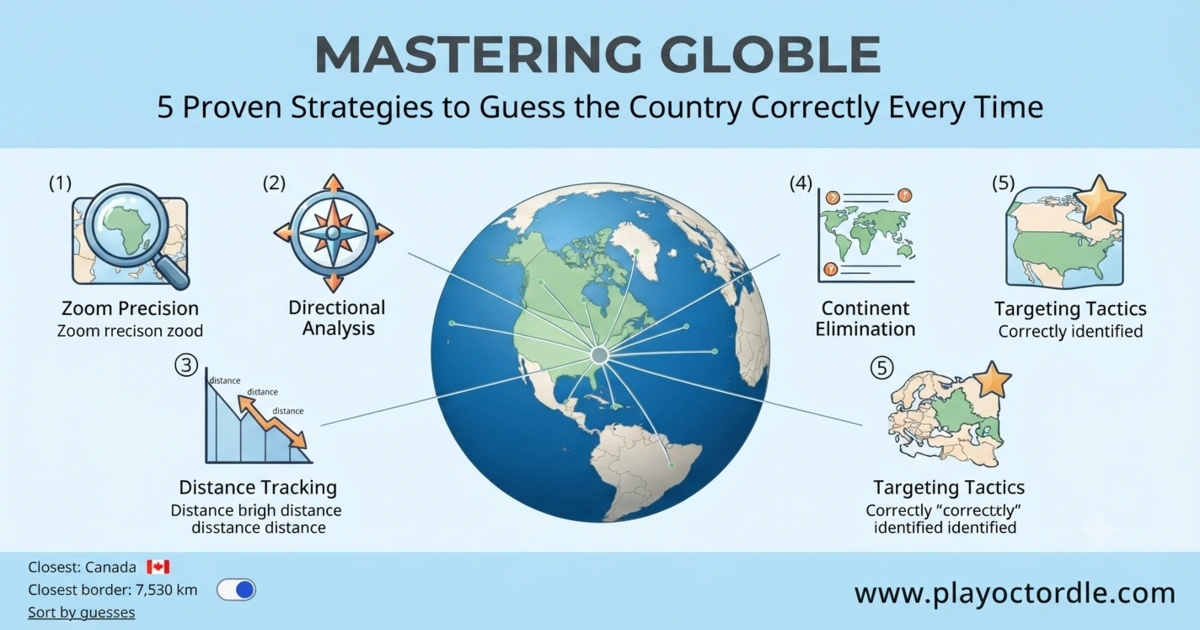
Mastering Globle: 5 Proven Strategies to Guess the Country Correctly Every Time
Do you feel like you are stuck guessing aimlessly in Globle? While the game is designed to be accessible to everyone, moving from a casual player to a geography master requires more than just a general knowledge of the map. To consistently shave down your attempt count, you need a systematic, analytical approach that turns every game into a logical deduction exercise.
In this comprehensive guide, we move beyond basic rules and dive into the advanced mechanics of the game. We will explore how to analyze the heatmap, how to manage the global map as a grid, and how to identify the mystery country with surgical precision. If you haven’t started your daily challenge yet, head over to play Globle and prepare to apply these tactics in real-time.
1. The “Anchor Method”: Strategic Starting Countries
Most casual players start with their home country or a random favorite. While this is fun, it is statistically inefficient. To master Globle, you must use the “Anchor Method.” Your goal in the first three guesses is not to find the answer, but to “divide the world” into manageable sectors.
The Triangulation Strategy
To identify the continent as quickly as possible, you need to use three “Anchor” countries that cover distinct geographic regions. A classic, high-efficiency starting set is:
- The Equator Anchor: Brazil or Indonesia. This tests if the mystery country is in the Southern or Northern Hemisphere.
- The Northern Powerhouse: Russia or Canada. This helps identify if the country is in the high-latitude Northern region.
- The African Pivot: Egypt or Nigeria. This identifies if the country is centrally located near the equator/Africa-Asia crossroads.
By placing these three distinct “anchors,” you will immediately see which region on the heatmap lights up. If all three are cold, you know exactly where to pivot. This technique saves you 2-3 guesses of random searching, which is the difference between a win and a loss.
2. Decoding the Heatmap: Understanding Proximity Logic
The heatmap is the most misunderstood feature of the game. Many players see a “warm” color and immediately start guessing every neighbor of that country. That is a tactical mistake because you are ignoring the Distance Gradient.
The Gradient Shift Rule: Do not just look at the color—look at the change in color between two specific guesses. If you guess Italy and get a “warm” color, then guess France and it gets “hotter,” you have successfully isolated the Mediterranean sub-region. However, if you guess France and it gets “cooler,” you know the mystery country is likely to the East or South of your initial guess.
Pro Tip: When you hit a “hot” zone, stop guessing major world powers. If the heat is high, the target is likely a small, neighboring nation, not another massive regional power. Switch your focus to the smaller, overlooked countries in that specific vicinity.
3. Mastering “Regional Clusters” and Trap Zones
Geography is tricky because some areas are incredibly dense with small, easily confused nations. The Caribbean, the Balkans, Central Asia (the “Stans”), and Southeast Asia are common “trap zones” for even experienced players.
The Strategy: When the heat indicates you are in a dense region (like West Africa or the Balkans), stop guessing randomly. Shift your focus to Border Neighbors. Many players lose their streak because they keep guessing major countries when the mystery location is a smaller state sandwiched between the ones they have already tried.
If you feel you are in a “cluster,” visualize the map and mentally zoom in. If you are in the Balkans, start with Slovenia or Croatia to check the Western side, or Bulgaria to check the East. Don’t guess the same country twice—this sounds obvious, but when you are frustrated, you will find yourself repeating guesses. Keep a mental (or physical) list of countries you have already eliminated in that cluster.
4. The “Latitude-Longitude” Mindset
The best Globle players treat every round like a detective case using a coordinate-based mindset. Ask yourself: “Is this country landlocked or coastal?”
If you have established that the mystery country is in Africa, your next logical step should not be a random country name, but a strategic geographic test. Guessing a coastal country like Nigeria versus a landlocked country like Niger gives you massive amounts of data about the target’s location relative to the coastline. Use these “test guesses” to narrow down the target’s position on the continent. If you eliminate all coastal countries in a region, you have effectively narrowed the field to the landlocked ones, significantly increasing your chances of finding the right country in the next turn.
5. Systematic Elimination: The Pro Workflow
Don’t fall into the trap of “Emotional Guessing.” If you are feeling frustrated or running out of ideas, you are more likely to guess a country based on impulse rather than logic. Follow this systematic workflow for every single game:
- Phase 1: Identify the Continent (Guesses 1-2): Use the Anchor Method to clear the board.
- Phase 2: Identify the Sub-region (Guesses 3-4): Test coastal vs. landlocked features or specific latitudinal bands.
- Phase 3: The Pinpoint Phase (Guesses 5+): Use logic to eliminate neighbors one by one. If the heatmap is “Hot,” look at a map of that region and guess the countries surrounding your “hottest” previous guess.
Did You Know? The top 1% of players don’t just “guess”; they “verify.” By the time they reach their 6th or 7th guess, they have mathematically eliminated 80% of the world map. They aren’t getting lucky; they are playing a game of process-of-elimination.
Final Thoughts: Consistency is Key
Mastering Globle isn’t about memorizing every border in the world—it’s about managing the data the game gives you. By using the Anchor Method to find the continent and the Border Exclusion technique to narrow down the specific location, you will drastically increase your win rate and solve puzzles faster than ever before.
Remember, the heat is your friend. Don’t be afraid of “cold” guesses—they are actually very valuable. Knowing where the country isn’t is just as important as knowing where it is. Every guess is a step closer to the mystery.
Are you ready to test these strategies? Challenge yourself today and see how many attempts it takes you to find the hidden country using these professional techniques!
If you enjoyed this guide and want to sharpen your skills further, don’t forget to explore other brain-teasing puzzles on our platform. Happy guessing!
 Octordle
 Byrdle
 Chessle
 Moviedle
 Statele
 Strands
 Travle
 Wordle 2
 Foodle
 Randle
 Wordle
 Scoredle
 Tridle
 Mathler
 Tradle
 Anti Wordle
 Squabble
 Duotrigordle
 Swiftle
 Flagle
 Scramble Words