The Ultimate Guide to Multi-Grid Word Games: How to Conquer Octordle, Quordle, and Sedecordle Simultaneously
Wordle captured global attention with its simple, elegant daily 5-letter challenge. However, for hardcore puzzle enthusiasts craving a steeper adrenaline rush, single-grid games eventually started to feel a bit too comfortable. Enter multi-grid word games—a thrilling evolution that multiplies the mental pressure, tests your vocabulary limits, and pushes strategic thinking to the absolute edge.
Managing games like Quordle, Octordle, and the monstrous Sedecordle requires a complete shift in mindset. You are no longer solving a single puzzle in isolation; you are juggling multiple boards, tracking dozens of eliminated letters, and balancing high-risk guesses across a shifting landscape. If you want to conquer these games without burning out or running out of guesses, you need a bulletproof strategy.
Understanding the Psychology of Multi-Grid Puzzles
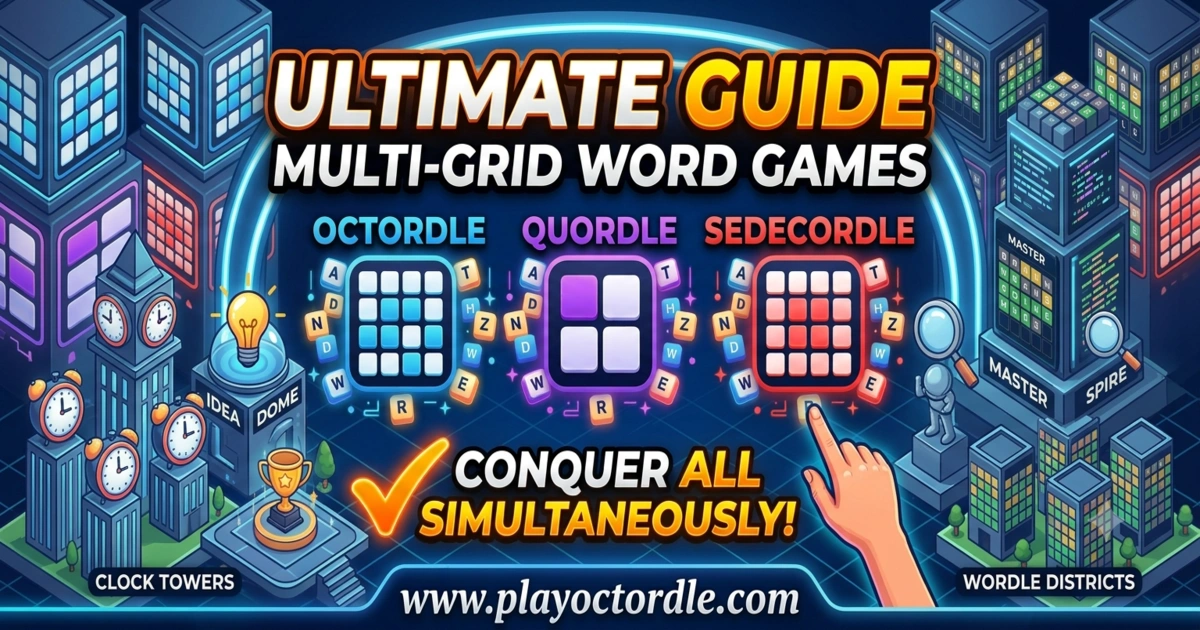
When transitioning from a standard single-grid format to a multi-board layout, the biggest hurdle is cognitive overload. Your brain is naturally wired to focus on one target. In games like Quordle, you must track four separate boards simultaneously. In Octordle, that number doubles to eight, and in Sedecordle, you are staring down an intimidating matrix of sixteen independent grids.
The secret to mastering these games isn’t having a massive vocabulary—though that certainly helps—it’s about pattern recognition and efficient information harvesting. Every guess you make must serve a dual purpose: eliminating incorrect letters while actively unlocking clues across as many active boards as possible.
Step 1: Mastering the Four-Board Baseline with Quordle
Before you can hope to conquer sixteen grids, you must master the four-board challenge. If you are looking to test your foundational multi-grid tactics, you can jump right in and play Quordle online to build your rhythm.
When playing a four-grid game, your first two or three guesses should be entirely dedicated to vowel exploration and common consonant placement. Words rich in letters like A, E, I, O, R, S, and T are your best friends. Do not waste early guesses trying to solve an individual board prematurely. Instead, cast a wide net. By the fourth row, you want to have enough green and yellow clues across all four boards to start narrowing down specific word patterns independently.
Step 2: Scaling Up to Octordle (Eight Boards)
Once you feel comfortable managing four boards, stepping up to Octordle introduces a new layer of complexity: guess economy. With eight boards running concurrently, you only have thirteen total guesses to solve all of them. That means you have very little room for wasted words.
Top strategies for Octordle success:
Prioritize Information Over Solutions: Spend your first 3 to 4 turns exclusively gathering data. Use high-frequency letter combinations to light up as many boards as possible.
Watch Out for Traps: Multi-grid games love to use words with double letters or tricky consonants (like V, W, X, or Z) near the end. Keep a mental tally of which boards are lagging behind.
Isolate and Conquer: As certain boards get solved early, your remaining guesses can be hyper-focused entirely on the stubborn grids that haven’t cracked yet.
Step 3: The Ultimate Test – Sedecordle (Sixteen Boards)
Sedecordle is the final boss of word puzzle gaming. Managing sixteen independent boards simultaneously sounds like madness, but it follows the exact same mathematical principles as smaller multi-grid games—just with razor-thin margins for error.
In Sedecordle, patience is your greatest asset. Rurshing your guesses will lead to quick failure. Treat your opening sequence as a scientific experiment. Every vowel placement must yield maximum feedback. Because you have more boards, you also have more opportunities to spot partial letter matches that can unlock multiple solutions in a single cascading turn.
Broaden Your Puzzle Horizons
If you love challenging your brain with diverse linguistic obstacles, don’t limit yourself to just one style. Exploring a wide variety of formats helps sharpen your lateral thinking and keeps your daily routine fresh and exciting. You can browse through our extensive collection of word puzzles to discover new daily challenges that test your spelling, pattern matching, and strategic deduction skills.
Final Pro Tips for Multi-Grid Mastery
To consistently come out on top in Octordle, Quordle, and beyond, keep these golden rules in mind:
Don’t Panic When Boards Turn Red: It’s completely normal for several boards to look blank or confusing in the middle stages of the game. Trust your process.
Keep a Scratchpad Handy: For intense sixteen-board sessions, writing down stubborn letter combinations on a physical piece of paper next to your keyboard can drastically reduce mental fatigue.
Establish a Daily Routine: Consistency breeds intuition. Playing these games daily trains your brain to recognize common letter clusters and English word structures instantly.
Multi-grid word games take the comfort of classic word puzzles and turn them into an exhilarating test of focus and strategy. By shifting your focus from individual solutions to broad information gathering, you’ll transform from a stressed-out guesser into a confident multi-grid master. Dive in, trust your vocabulary, and enjoy the challenge!
 Octordle
 Sudoku Classic
 Tied Up
 Tunnel Ball
 Sudoku Express
 Wordie
 Tribar
 Sticker Puzzle Book
 Treasures Of The Mystic Sea
 Sudoku Challenges
 Sudoku Blocks
 Sudoku Challenge
 Hard Crossword
 Easy Crossword
 Quick Crossword
 Taylordle
 Primel
 Horsle
 Flickle
 Squaredle
 Worldle